Thursday, October 17, 2019

Fieldwork Group 2

This past week group two had their chance to teach the class. They did a great job and I am glad that I got to watch them!


Group two taught about culture and immigration in their direct lesson. Some of the students seemed to never have heard of immigration so it was very interesting to see them learn. I liked the topic and the group did a great job of introducing new vocabulary. For guided practice, the group utilized a matching game and even had the students come to the board and write the correct answers. 


Next group two moved on to inquiry. Personally, I loved their inquiry and thought that it was very creative!! The problem that they posed was that students who were traveling got their suitcases mixed up and it was up to the students to correct the problem. The group utilized mystery bags so that the students could guess where the bag came from based off of the items inside. The students had a lot of fun doing this and were able to guess right away. The teachers provided packets full of information for the students to give them some background knowledge. The students also watched videos on the area that their suitcase was from in order to give fun facts to the class. I think this lesson went really well and I enjoyed watching it!


Finally, it was time for group two's cooperative lesson. For this they had the class create scrapbooks for different immigrants. The students were given stories and had to put the story in order from the beginning, to the middle, to end. The students then had to create drawings and pictures and share their creations with the class. The students did a great job and the scrapbooks came out amazing!

Overall, group two did great and I am excited to teach my lesson next week!


Tuesday, October 8, 2019

Fieldwork Group 1

This past week the first group taught their lessons! Being first can be difficult, but this group did great!


Group one taught about the different types of communities: urban, suburban, and rural. In their direct lesson, this group went over vocabulary words such as urbanization, citizens, Ellis Island, ancestors, symbols, and Statue of Liberty. The group also taught the class about Newburgh and how it was founded. I liked how they included this because it related to the students and their home. The group also went into the benefits and problems with urbanization and discussed the pros and cons. For guided practice, the group did matching, a chart, and a quizlet game. 

Group one continued their study on communities by doing an inquiry lesson. The students met Emily, a girl who was living in a community that was becoming urbanized. They asked students to read about the positive and negative effects of urbanization on communities. After reading about urbanization the students were to fill out a chart about the good and bad sides of urbanization. Then the students were to decide if they felt if Emily should move or not. The students wrote a letter to share their feelings. This lesson went exactly with what they learned in direct and was a good continuation of learning. 

After learning all about communities, for the cooperative lesson, the group had the students create their own community. Students were to make a poster that included a community type and who lives in that community, one interesting thing to do with the community, and an issue in the community. Students then shared their creations. The posters were very creative and showed how much students learned over the lessons.

I loved watching group one, and I can't wait to see what the next group comes up with!

Thursday, September 26, 2019

First day of fieldwork!

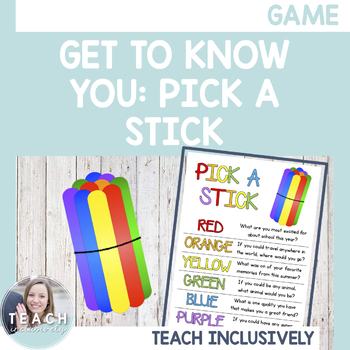
Image result for pick a stick


Today we had the opportunity to meet our fieldwork students! We had to do a getting to know you activity to be able to teach our students on a more personal level. Each group had to choose an activity and we rotated around to groups of students to make sure we met all of the students. My group decided to do the "pick a stick" activity. For that activity we had a jar full of colored sticks. Each color had a specific question that the student needed to answer. Questions included:

  • "What is one fun thing that you did this summer?"
  • "If you could have any superpower what would it be and why?"
  • "If you could go anywhere on vacation, where would you go and what would you do?"
  • "What is your favorite subject?"
  • "What is your favorite book? What is your favorite movie?"
  • "If you could be any animal what would you be and why?"
I learned a lot about the students, but mostly that they were a very funny group. Most students were not shy and many were very excited for the activity. Students were excited to share about their lives which helped me to prepare my lesson better. When teaching the class I learned that I need to have breaks within my lesson to get the students attention back. They often get very excited so it is important to have calming breaks to get them back on track. 

Meeting the students was very exciting, and I can not wait to fully get into the field!

Sunday, September 22, 2019

Assessments

Image result for assessment


Assessment is vital in the classroom because it is needed to see how students are learning. When asked the questions, "How do we know students are learning?" and "How do we know our teaching is effective?", both have the same answer: Assessment and Evaluation. Both of those tools are used to check that students are learning, and if students are learning then that means that our teaching is effective. 
     
An assessment of learning is a summative assessment, meaning that it is a check at the end of a unit or year to see what was learned. It is to make sure the student understood the entire topic. An assessment for learning is formative assessment, meaning that it occurs during the learning process. It is to check up with students while they are learning to make sure they are understanding concepts and to clear up any issues that there may be. 

To learn more about assessment and feedback, I read the article Seven Keys to Effective Feedback that was found on Eclass. This article defined feedback as information about how we are doing in our efforts to reach a goal. Helpful feedback is goal-referenced, tangible and transparent, actionable, user-friendly, timely, ongoing, and consistent. The article also discusses the difference between feedback and advice. For example, just saying "You need more examples in your report", there is nothing to learn from that. It is not tangible, or actionable, it does not provide resources on how to do that. Same with evaluation and grades. Just saying "Good work!" or "This is a weak paper" does not give the student any actionable information about what occurred. You only receive a judgment on your work, not how to improve it. 

Reading this article was interesting to me because I do not think I ever really considered the difference between advice, evaluation, and feedback. I thought that saying "Good presentation!" was a form of positive feedback. But feedback needs to provide something like being oriented towards a goal or giving an action to complete. This article is important to me because as a teacher I will be giving my students feedback to help them improve, and I want to make sure that my feedback is valuable to them. By reading this, I learned how to provide feedback to help the student improve. 

Wednesday, September 18, 2019

Current Events Project

Image result for current events article


     For our Social Studies Methods class, we had to do a project on current events and how to analyze them. My group decided to teach the 5 W's: Who, What, Where, When, and Why (and sometimes How). To do so, we decided to do an activity on how to listen and take notes when reading an article using the 5 W's.
     To begin our activity we first explained what the 5 W's were and how you can use them. We then went over helpful tips to take notes and listen. The listening aspect was important because not all current events are articles, they can also be videos or news reports. We next showed a video on Hurricane Dorian. We had taken notes using the 5 W's as an example and showed the class what we came up with.
     After we felt that the class had a good understanding we moved on to our task for the day. We had the students read an article and take notes using the 5 W's. They then turned and talked with a partner to summarize what they had read. Finally, they answered questions regarding the article.
     Learning through current events in the classroom is important because it is a way to teach students how to analyze and synthesis information while also keeping them informed about what is occurring in the world. We chose the method we did because since we were the first group to present we felt it would be a good foundation to begin upon. We found the ideas from the websites provided to us on Eclass and also incorporated our own experience with using current events and taking notes. This assignment can be used in both grade one and grade six but of course, needs to be edited to fix their grade level. For example, for grade one, you can introduce the idea of the 5 W's and try and identify them in an article the teacher reads aloud or in a video that is played. For grade six, you can make the assignment more complex by giving them a more difficult article and asking them why they feel the event is important and how it relates to other events they have learned about.
    For this assignment, I used the site Newsela. On this website, you can either sign in as a teacher or a student. If you are a teacher you are able to assign specific articles to your students. What I liked most about this website is that it allowed you to pick specific levels for different students. For example, I could choose an article at an upper or lower elementary level. If I wanted to be more specific I could choose the exact grade that I wanted to work with. If I was a third-grade teacher, I could limit my search to only third grade. This site would be effective in a social studies classroom because you can search for specific topics that you are discussing in class. If you are learning about money, you can search for all articles regarding money. If you are doing a specific unit you can use these current event articles to support what you are teaching and show the students how what they are learning is in the world today.
     For next semester I feel that the assignment can be more clearly defined. My group went first and we were very confused about where to start and what to do. We tried to follow the examples as best we could but still were informed that we taught too much. Maybe providing more clear examples of what is expected could be helpful. Overall, I felt that this assignment was valuable because it showed us how to incorporate current events into our future classrooms. 

Tuesday, September 10, 2019

Social Skills

Cooperative learning is important, but in order to work successfully in groups, social skills are needed. So, what is a social skill?


Social skills are the skills we use to communicate and interact with each other both verbally and non verbally through gestures, body language, and our personal appearance. For example, following directions is an example of a nonverbal social skill that children should learn.

An important aspect of utilizing social skills is face to face interaction. Face to face interaction not just a basic element of a social system, it:
  • Boosts successful relationships
  • Is perceived as credible
  • A great form of persuasion, engagement, and leadership


It is important to use face to face interaction in the classroom, and it works best when the desks are positioned in tables or groups rather than rows. Below is a good example of how to promote face to face interaction in the classroom.


There are four skills needed for cooperative learning: functioning skills, forming skills, formulating skills, and fermenting skills.
  1. Functioning skills are needed to manage the group's activities to complete a task. They help to maintain effective working relationships among members.
  2. Forming skills are basic skills that are needed for functioning in a social situation. They are required for cooperative learning groups. Examples include taking turns and using quiet voices. 
  3. Formulating skills are needed to understand the material that is being studied at a deeper level. These skills stimulate the use of higher quality reasoning strategies and maximize mastery and retention. 
  4. Fermenting skills are needed to rethink the material that is being studied. They can be used to manage cognitive conflict, search for more information, and to communicate the rationale behind one's conclusion
There are five steps to teach social skills. They are as follows:
  1. Discuss the need for social skills and make sure students understand why they need them. Demonstrating the skill yourself can be helpful
  2. Make sure the students understand what the skill is and how and when to use it. Using a T-chart is helpful for this
  3. Set up practice situations and allow for guided practice
  4. Give students feedback on their use of the skill
  5. Make sure students practice the skill until it becomes automatic

Social skills are just like any skill in life, meaning that they often need practice before they are perfected. Making sure you provide practice in the specific skill is vital for students understanding. 

Being able to socialize and work in a group setting is not only vital in the classroom, but also in life in general. It is important that we give students a strong foundation in these skills so they can perfect it and utilize it later in life.


Sunday, September 8, 2019

Cooperative Learning

When I first heard that we were required to teach a cooperative lesson during fieldwork, I have to admit that I was nervous. I had never heard of a cooperative lesson during any of my other education classes, and teaching one myself seemed like a daunting task. But after reading and viewing the sources that Dr. Smirnova provided on Eclass I feel that I am more informed on the lesson type and am ready to attempt to teach one in the coming weeks. 


Cooperative learning consists of interdependent learning in small groups. This learning strategy recognizes both the groups and the individual's effort. It is a cooperative strategy, not a competitive, meaning that students are meant to work together in groups rather than against each other. This process is democratic and students in each group assume active roles. From a teacher standpoint, there is less of an emphasis on organizing academic content and more on organizing students into small group work and collecting a variety of learning materials to be utilized. 

There are six phases to cooperative learning, which are as follows:
1. Present goals and establish set goals
2. Present the information to the students
3. Organize students into learning teams
4. Assist teamwork and study
5. Test students on material
6. Provide recognition 


Of course, there is always the question of why? Why use cooperative learning? Studies show that students who work in cooperative learning groups perform better on tests, especially in regard to reasoning and critical thinking skills. Cooperative learning also has been seen to enhance the achievement of underrepresented groups such as females and African Americans. In addition, it creates more active participants in learning. From a social standpoint, it allows students to make friends more easily. Students learn accountability for they are to "sink or swim" together and are depending on one another for success. 

Cooperative learning builds a community in your classroom and allows students to learn how to work and depend on each other. It is a strategy that every educator should incorporate into their classroom. 

Time to Reflect!

In every class that I have taken with her, what Dr. Smirnova has emphasized most is the importance of reflection. You can never ...